

OPINION — In the late 19th century, Texas stood at a crossroads—quite literally. The arrival of railroads promised unprecedented connectivity, economic vitality, and growth, but not every community seized the opportunity. Towns that embraced the rails boomed into bustling hubs, while those that shunned them or were bypassed withered into obscurity. Today, San Angelo faces a similar pivotal moment with the proposed arrival of data centers, the modern equivalent of those iron tracks. These facilities, powering the AI-driven digital economy, could incubate innovation, create jobs, and propel our city into a land of opportunity for all.
Drawing from Texas' railroad history—and now, Abilene's contemporary "second act" with its massive Stargate data center project—it's clear: resisting progress leads to stagnation. San Angelo must welcome data centers to thrive, not fade like the bypassed towns of yesteryear.
Lessons from the Rails in Texas
Texas' economic development history is inextricably linked to railroads, which transformed isolated outposts into economic powerhouses. Towns that actively courted rail lines saw explosive growth. Take Abilene: In the 1880s, when the Texas and Pacific Railway considered bypassing the area in favor of Buffalo Gap, local cattlemen and developers rallied, offering land and incentives to reroute the tracks through their nascent town. The result? Abilene became a major cattle-shipping center, its population surging as commerce flowed in. Similarly, Dallas leveraged rail connections starting in 1872, evolving from a modest settlement into a commercial giant by the end of the 19th century, with multiple lines converging to fuel trade in cotton, oil, and goods.
Other communities flourished by design. Rosenberg, southwest of Houston, boomed after welcoming the Gulf, Colorado and Santa Fe Railway in the 1880s, supplanting nearby Richmond, which reportedly refused right-of-way concessions. Temple grew as a junction for the Missouri-Kansas-Texas Railroad, becoming a medical and transportation hub. Marshall, already a cotton center, solidified its status with the Texas and Pacific's arrival in 1873, hosting workshops and depots that employed hundreds. These towns didn't just survive—they innovated, attracting industries, immigrants, and investment that built schools, hospitals, and lasting prosperity.
Contrast this with the fates of those that resisted or were overlooked. Buffalo Gap, once Taylor County's seat, declined after the railroad favored Abilene, its population dwindling as businesses migrated. Helena in Karnes County saw its growth halt when the San Antonio and Aransas Pass Railway curved around it in the 1880s, bypassing the town due to local disputes or terrain—today, it's a shadow of its former self, with Highway 181 tracing the old "Big Curve." Brackettville in Kinney County offers another cautionary tale: Initially planned for inclusion, it was bypassed by the Galveston, Harrisburg and San Antonio Railway in 1882, which opted for a route ten miles south, limiting its expansion despite its role as a wool and hides shipping point tied to its U.S. Army base called Fort Clark. This decision redirected growth to Del Rio, 30 miles west, transforming a small settlement around San Felipe Springs into a regional hub; by the 1890s, Del Rio's population had swelled to 2,000, fueled by railroad connectivity that boosted sheep and goat ranching, wool trade, and later military and tourism developments. Whitt in Parker County began fading in the early 1900s after being bypassed, exacerbated by the Great Depression. Stiles in Reagan County started declining in 1911 when the Kansas City, Mexico and Orient Railway skipped it, and oil booms elsewhere sealed its fate as a near-ghost town. Pittsville in Wood County suffered similarly in the late 1880s, its bypassed status leading to depopulation.
These stories aren't anomalies; they're patterns. Railroads brought jobs in construction, maintenance, and shipping, spurred related industries like lumber and agriculture, and connected towns to national markets. Shunning them—whether through pride, short-sightedness, or failed negotiations—meant isolation and economic demotion.
Hugh Hemphill, manager of the Texas Transportation Museum in San Antonio, is quoted in a May 2025 article in *Texas Highways* summarizing the railroad question for communities during the Gilded Age. He noted that "every town in Texas of any significance was created because of a railroad or bolted onto one."
The lesson? Infrastructure isn't optional; it's the lifeline of progress.
In Abilene's Second Act, Who Becomes the Next Buffalo Gap?
Abilene's story doesn't end with the railroads—it's scripting a remarkable second act in the 2020s, once again positioning itself as a forward-thinking hub by attracting cutting-edge infrastructure. Just as it lured the Texas and Pacific Railway away from Buffalo Gap in the 1880s, Abilene is now home to the flagship Stargate project, a $500 billion AI data center initiative spearheaded by OpenAI, Oracle, Crusoe Energy, and partners like Lancium and SoftBank. The debut campus in Abilene, operational since September 2025, features Oracle Cloud infrastructure and Nvidia racks, with expansions including five new sites putting the project ahead of schedule for its 10-gigawatt commitment. This gigawatt-scale facility, funded in part by a $2.3 billion loan from JPMorgan Chase, is touted as one of the largest data centers globally, with construction phases topping out by late 2025 and full completion eyed for summer 2026.
Local leaders in Abilene have addressed community concerns over water and electricity usage, implementing sustainable measures to ensure the project's viability without straining resources. The economic ripple effects are already evident: thousands of construction jobs, ongoing operational roles in AI and tech, and a boost to the local economy through increased tax revenues and ancillary businesses. Drone footage and media tours highlight the site's rapid progress, transforming Abilene into a West Texas tech powerhouse. This isn't just infrastructure—it's Abilene reinventing itself for the digital age, much like it did with railroads 140 years ago.
San Angelo's Catbird Seat in the AI Boom
Today, data centers represent the new rails—vast facilities housing servers that underpin AI, cloud computing, and global connectivity. San Angelo is already on the cusp: Skybox Datacenters has proposed a hyperscale project on 343-374 acres of city-owned land northeast of town, near U.S. Highway 67 and City Farm Road.
Arthur Stilwell's Kansas City, Mexico and Orient Railway ended in heartbreak and an abandoned rail line with San Angelo as a hub, but for the modern economic battles, San Angelo should have the upper hand over Abilene.
San Angelo historically led telecommunications throughout the 20th century because General Telephone of the Southwest (GTE Southwest) was headquartered here at 2701 S. Johnson St. GTE's headquarters elevated San Angelo's telecom infrastructure, providing robust connectivity that supported economic stability during challenges like the Great Depression, storms, and floods, and the dot-com boom in the late 1990s and early 2000s. GTE bought out the former San Angelo Telephone Company to establish GTE Southwest and moved its headquarters here from Durant, Oklahoma, in the early 1950s. GTE also nurtured local talent, such as James L. "Rocky" Johnson, who advanced from clerk to GTE CEO by 1998. Today, the E.H. Danner Museum of Telephony at Angelo State University preserves artifacts from this era, including switchboards and early phones, underscoring San Angelo's enduring telecom heritage.
What no one advocating for the Skybox Datacenter has mentioned is that in that same old six-story GTE building, situated in the backyards of a fairly affluent neighborhood, today houses a rather large datacenter called Cloudnium's SANG-TX facility. The 30,000- to 38,000-square-foot facility has been in operation on one floor of the old GTE building for about a year and a half, and there is a plan to expand its capacity from 7.8 MW to 50 MW in electricity use.
While the Chamber crowd hasn't mentioned the Cloudnium facility, its existence silences vocal opposition to projects like Skybox. It is located almost inside a residential area on a lot zoned for General Commercial and Heavy Commercial use. Cloudnium is much closer to San Angelo's posh Santa Rita than PaulAnn is to Skybox, and we haven't heard a peep about noise from San Angelo's gilded classes despite Cloudnium's 9,000-gallon diesel engine backup generators. Water remains plentiful, and no one is experiencing electrical blackouts.
The second point here, over and above a current use case that annihilates the opposition's argument, is that San Angelo has the heritage and infrastructure to grab a large swath of the AI buildout, but lackluster advocacy and an emerging vocal opposition of naysayers is killing the community's sales vibe.
Now is the time to advocate for incubation, not hesitation.
Like railroads, data centers promise transformative benefits for San Angelo. They create high-quality jobs in construction (thousands short-term), operations (hundreds long-term in tech, engineering, and support), and ancillary sectors like logistics and energy. Tax revenues surge—Meta's data center in Temple, for instance, has contributed millions to local schools and services since 2022. Infrastructure upgrades follow: enhanced power grids, fiber optics, and water systems modernize communities, attracting further investment. In San Angelo, this could mean bolstering our economy beyond agriculture and military, fostering startups, education in STEM, and positioning us as a West Texas tech hub.
Critics raise valid concerns—water usage, grid strain, and preserving rural charm—echoing 19th-century fears of railroads disrupting farms or bringing "outsiders." Yet, history shows adaptation wins. Railroads demanded water for steam engines and land for tracks, but communities negotiated solutions, like incentives or reroutes. Today, data centers can incorporate sustainable tech—air cooling, recycled water, renewable energy—to mitigate impacts. Texas' deregulated market and abundant land make us ideal, but we must ensure local benefits through community agreements, as emphasized in recent studies.
Will San Angelo Become the Next Buffalo Gap or Brackettville
San Angelo risks the fate of Buffalo Gap or Brackettville if we shun data centers—demoted to economic irrelevance as growth shifts to welcoming neighbors like Midland or Abilene. Abilene's Stargate success story is a stark warning: By embracing data centers in the 2020s, it's building on its railroad legacy, potentially leaving San Angelo as the bypassed "Buffalo Gap" of this era. Instead, let's emulate Abilene's playbook: Offer incentives, plan sustainably, and incubate this industry. Partner with Angelo State University and Howard College for workforce training, negotiate water-efficient designs, and channel City of San Angelo Development Corporation (COSA-DC) revenues into community projects that support AI infrastructure. The digital economy is barreling forward; San Angelo can ride the wave or watch from the sidelines.
Just as railroads knit Texas into a powerhouse state, data centers can connect us to future prosperity. Let's not repeat history's mistakes—welcome them, and watch San Angelo boom.
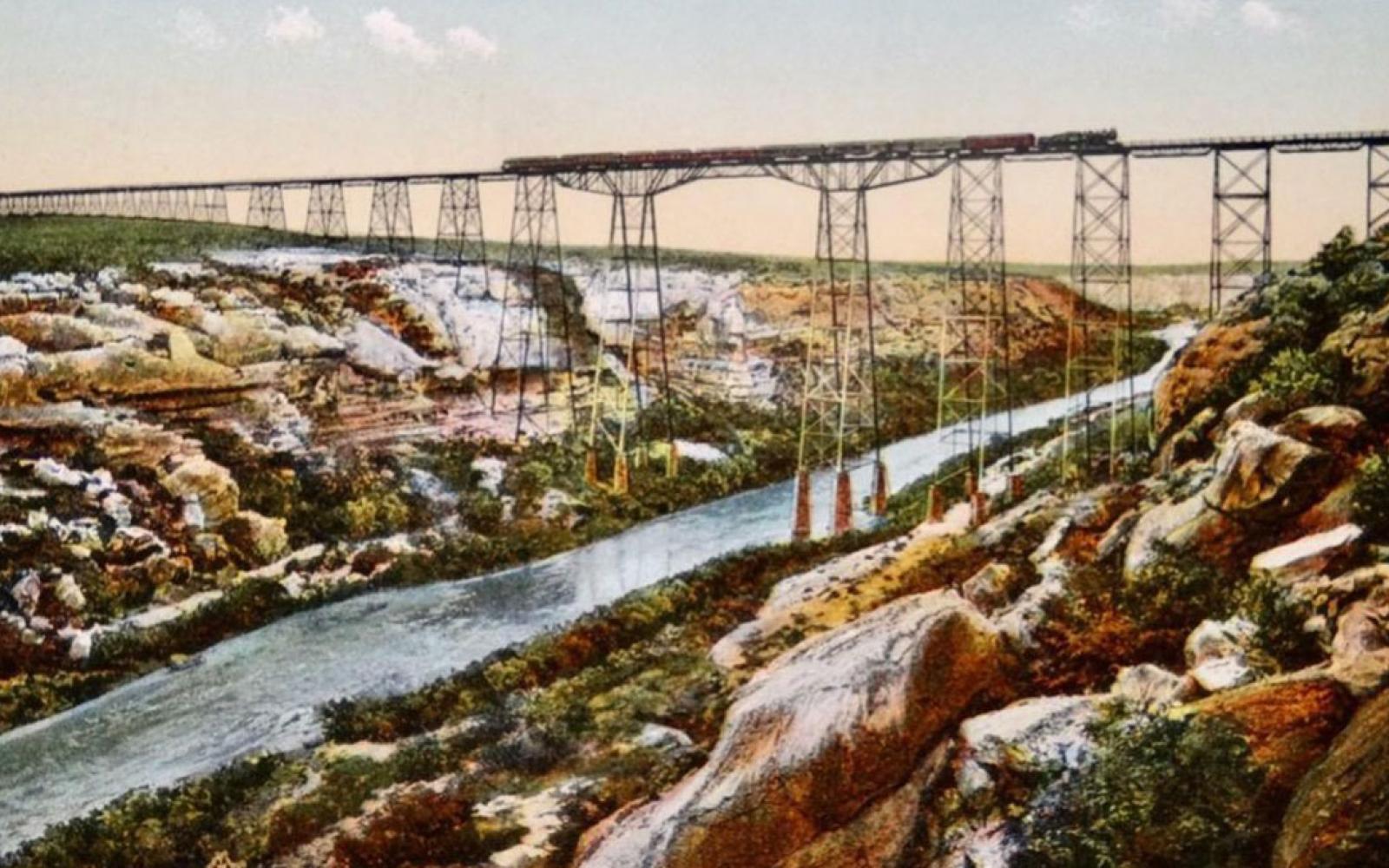
Postcard with image Pecos River Railroad High Bridge Texas just west of Del Rio. The postcard was postmarked Dec. 11, 1912.



Subscribe to the LIVE! Daily

Required
Comments
Listed By: Rita Repulsa
Personally, I'm torn between taking Skynet Datacenter's offer and perpetuating San Angelo's heritage of economic irrelevance. Our motto has always been to "keep San Angelo backwards," operating ineffeciently, ineffectually, and with enough chaos in the underperformance to skim off the top. (*Wink-wink, nudge-nudge*)
However, now we have an opportunity to prove to Skynet itself what useful and corruptible minions we can be. Should we offer up our bodies, souls, and DNA sequences to the AI monster that will rule the world once it crushes humanity beneath its robotic feet?
Why not of the biological feet of the "morlocks" Skynet will mutate us into once we become its servant homunculi? Why refuse the opportunity to be the biological "shoe leather" of the bottom rung of a vast robotic hierarchy that will stretch into the galaxy on the backs of reusable rockets? What could be more "backward" than being degenerated, servile homunculi that constitute the mutated vestiges of the human race we will help to eliminate?
This the future, whether you like it or not.
- Log in or register to post comments
PermalinkListed By: Gus Clemens
Well said (written) Joe Hyde. With ASU, Howard College, and Goodfellow, San Angelo is a natural for AI growth. One of the big problems some communities face when embracing an AI facility is few people who know how to service the AI needs want to live in the town where the AI center is located. San Angelo does not have that problem. We should embrace this inevitable part of our world's future.
- Log in or register to post comments
PermalinkListed By: Rita Repulsa
Thank you for succinctly restating what I wrote with far more elegance and grace.
- Log in or register to post comments
PermalinkThere will be no future when AI takes over. All manual labor jobs and even most skilled jobs will be outsourced to robots who won't require pay. Heavy machinery operators will lose their jobs, oilfield workers will sit unemployed, even fast food will go the way of a fully automated restaurant putting even the lowest on the totem pole of employment out of work.. AI is the beginning of the end of our civilization and will most likely end a way of life for billions of people. I hope that if we do get an AI facility here that someone sets it on fire or blows it to kingdom come. We don't need AI and never have.
- Log in or register to post comments
PermalinkListed By: Rita Repulsa
Yes, AI is the beginning of the end of our civilization, but hasn't the very act of living in San Angelo demonstrated to you why that's absolutely necessary for life on Earth to flourish?
Besides, if we don't let the data center pay taxes to the city, it will just move to Wall or Veribest, and VeribestLive! will likely go with it...
- Log in or register to post comments
PermalinkLet them!! They can find out the hard way there isn't even enough water in TGC for a data collection/ai center.
- Log in or register to post comments
PermalinkPost a comment to this article here: