

SAN ANGELO, TX — State Rep. Drew Darby hosted a conversation with State Sen. Charles Perry and Texas House Speaker Dustin Burrows to open the 22nd annual West Texas Legislative Summit, organized by Angelo State University and the San Angelo Chamber of Commerce at the C.J. Davidson Conference Center at ASU on Thursday, August 6, 2026.
The two-day event began with a soiree Wednesday evening and continued Thursday with a full day of political speeches and roundtable discussions. In the opening session, Burrows and Perry highlighted legislation they considered most significant from the 89th legislative session and sketched early priorities for the 90th session that begins in January 2027.
Burrows said from last session he was most proud of the Teachers’ Bill of Rights. Senate Bill 27 and House Bill 6 strengthened classroom authority for Texas public school teachers. The legislation gives teachers clearer legal authority to remove disruptive or threatening students and manage discipline with less administrative interference. It also refined formal grievance procedures and expanded flexible contract options for school districts.
Burrows also pointed to a quieter but important change: the statewide ban on cell phones in classrooms.
“Test scores are going to go up,” he predicted.
The two lawmakers then turned to the next session and offered different emphases. Burrows called for further property tax reduction, ways to lower health, property and casualty insurance rates, and broader work on affordability. Perry stressed infrastructure investment and protecting the ability of counties and cities to manage their own needs.
Burrows said the Legislature should pursue measures to make health insurance more affordable and examine ways to lower property and casualty rates.
Darby then highlighted Perry’s ongoing work on produced water — the wastewater generated by oil and gas operations in West Texas. For every barrel of oil produced, operators typically generate four to five barrels of produced water.
Perry said he is traveling to Orla, a small community between Pecos and the New Mexico border, to examine new desalination technology that could treat produced water to a standard suitable for agricultural use.
“I’d drink it,” Perry said.
Reusing the water is far preferable to the current practice of injecting it underground as waste, he added. Texas Pacific Land is testing a 10,000-barrel-per-day research desalination facility in Orla and expects to begin accepting produced water in the coming months.
The desalination efforts are supported by a January 2025 memorandum of understanding among Texas Tech University, Abilene Christian University, Natura Resources and the Texas Produced Water Consortium. The partnership aims to advance molten salt reactor technology that could help power desalination systems and purify produced water for beneficial reuse.
“You cannot separate power and water,” Perry said.
An appropriation signed by Gov. Greg Abbott directs funding to Texas Tech to accelerate produced-water research in partnership with ACU and Natura Resources and to complete construction of the molten salt research reactor in Abilene.
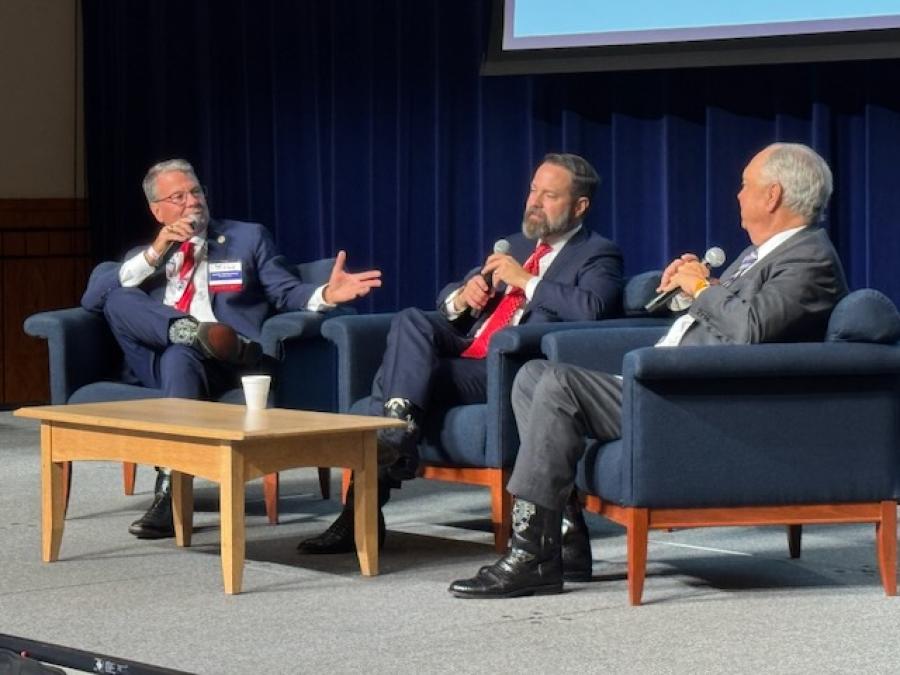
Texas Senator Charles Perry, House Speaker Dustin Burrows, and State Representative Drew Darby at the 2026 West Texas Legislative Summit
Darby noted that lawmakers are also examining ways to reduce earthquakes linked to injection wells by giving the Texas Railroad Commission clearer authority to site disposal wells. Expanded desalination capacity, he said, could eventually reduce the need for those wells.
Burrows returned to what he expects will be a dominant theme next session.
“Property tax reduction will dominate,” he predicted. “We will need significant allocations to buy down the Maintenance and Operations tax rates” for school districts. Darby agreed, noting the frustration his constituents feel each summer with appraisal district processes.
Perry offered a more constrained budget outlook. He said the Legislature is likely to have roughly $8 billion in surplus funds available. About $5 billion is already spoken for, leaving approximately $3 billion for new initiatives. Back in July, Abbott, Lt. Gov. Dan Patrick and Burrows have directed state agencies to reduce base spending requests by 3 percent. The era of $20 billion budget surpluses has ended.
“I’m kind of a spreadsheet guy,” Perry told Burrows. He argued Texas needs to fund a $173 million water infrastructure plan and give counties and municipalities the tools to finance their own roads and water systems.
“We need to address these long-term deferred infrastructure issues,” he said.
Perry warned that further limits on local revenue-raising authority only accelerate deferred maintenance. State policy, he said, should encourage local governments to solve their own problems because “most people want their roads to connect, their potties to flush and water to flow out of their taps.” If the state begins funding everything, he added, government becomes centralized in Austin rather than remaining in local city halls and county offices.
Burrows interjected that he is hearing a different message across the state.
“What I am hearing across the state now is that people are afraid in this economy. We have affordability issues that are real. Some are afraid they can’t afford their property tax payment to stay in their homes.” He also cited concerns about high insurance rates.
“Inflation is temporary,” Perry responded. He pointed to the large increase in the money supply during the COVID period and subsequent inflation rates of 8 to 10 percent, noting that it typically takes five or six years to work through such pressures. The war with Iran, he said, temporarily renewed inflationary pressure, but that too will pass.
By the end of the exchange, Perry acknowledged that affordability concerns are genuine. Before committing large portions of the state budget to further school-district tax-rate compression, however, he said lawmakers should first understand statewide infrastructure needs and ensure that municipalities, counties and school districts retain pathways to fund their own long-term requirements.


Subscribe to the LIVE! Daily

Required
Post a comment to this article here: