

CIUDAD ACUÑA, Coahuila — Twenty Coahuila municipalities signed a four-year memorandum of understanding here Sept. 9 to plan and promote the Ciudad Acuña–Torreón Multimodal Highway Corridor, the Mexican road network that puts trucks on the Del Rio international bridge and, from there, onto U.S. 277 toward San Angelo.
The signing was the centerpiece of the Acuña day of the 2026 Ports-to-Plains Alliance Annual Conference, held Sept. 8–10 in Del Rio and Acuña. Organizers said nearly 300 government, transportation, business and community leaders from Mexico, the United States and Canada attended. The theme was “Building the Future Interstate: Bridging from Designation to Delivery.”
The MOU is a declaration of intent that is seeking highway funding, not a final step. It creates an Intermunicipal Technical Committee and a Regional Follow-Up Technical Committee to work with the Coahuila state government and the Ports-to-Plains Alliance on highway upgrades, logistics, investment, tourism and freight safety. The initial term is four years from signature.
The San Angelo connection
On the Texas side, that same corridor is Future Interstate 27. From Del Rio the route follows U.S. 277 north through Sonora to San Angelo, then U.S. 87 toward Big Spring, Lamesa and Lubbock, where existing I-27 already runs. TxDOT describes the Texas I-27 system as a 963-mile network touching Laredo, Eagle Pass and Del Rio and spanning 26 counties.
San Angelo has been in that fight for years. An I-27 signage ceremony in April 2025 marked the first physical southward extension of the interstate from Lubbock toward the Concho Valley. Former Mayor Brenda Gunter chaired the state’s I-27 Advisory Committee and has served as Ports-to-Plains treasurer. Current Mayor Tom Thompson has briefed the same committee on local projects.
The Mexican municipalities are organizing the roads that feed the Rio Grande crossing in Del Rio. On this side, the road those trucks would use through San Angelo is still mostly in study, with only one nearby package close to a letting.
What I-27 construction actually looks like
I-27 is not one project with one opening date. Only about 124 miles have I-27 signs today, from Amarillo to south Lubbock, plus a 4.2-mile stub added south of Loop 289 in 2024–25. Everything else is still U.S. 87, U.S. 277, U.S. 83, SH 158, SH 349 and connecting roads waiting to meet interstate standards.
TxDOT’s implementation plan is slowly bringing the full system up to interstate standard but it is a decades-long job. Official buckets are near-term (0–4 years), mid-term (5–10 years) and long-term (10-plus years). Building a typical segment, once it finally gets funding, takes two to four years. The years before that involve incorporating the schematic, environmental, right-of-way, utilities, often take longer than the construction.
April 2026 numbers from the I-27 Advisory Committee and the 2026 Unified Transportation Program put the scale of the money to be spent into focus:
- Seven added-capacity projects under construction: about 40 miles, $750 million
- Eight fully funded construction projects in the UTP: 12.7 miles, $774 million
- Forty-two projects still in planning or only partly funded: 342 miles, $9.26 billion
- All I-27-related work in the 10-year UTP window: about $2.55 billion
Ports-to-Plains cites more than $1.12 billion fully funded for 2026–2030 and about $823 million already under construction and that is is only a fraction of the dollars needed for a full buildout. One Laredo-district package alone, 253 miles of U.S. 83, was estimated at $10.86 billion in the implementation plan.
The money is going first to stretches that already look like freeways: I-35 in Laredo, Loop 335 in Amarillo, U.S. 87 in Lubbock, I-20 in the Permian. The long two-lane rural miles between San Angelo and Del Rio, and between San Angelo and Big Spring, are still mostly paper.
What San Angelo will see in the near future of I-27
The San Angelo District has three near-term, six mid-term and seven long-term interstate-upgrade recommendations, plus four city-location studies. Those studies are reviews TxDOT orders when widening the existing road through town.
The project that would eventually let Ports-to-Plains, or future I-27, traffic skip the city is the San Angelo North Relief Route (CSJ 0907-24-055). This is about 11 miles of new road between U.S. 87 and U.S. 67 north of town. The ultimate section is three mainlanes each way, two-lane frontage roads, roughly 500 feet of right-of-way and about 575 acres of new ROW, with interchanges at U.S. 87, U.S. 277 and U.S. 67.
As of April 2026 the schematic and environmental work was about 60 percent complete. Federal environmental review is targeted for June 28, 2027. Right-of-way buying is slated for 2030. Construction is set to begin in April 2032 — first the frontage roads, about $113 million. Mainlanes come later as a separate, still-unfunded phase. Tom Green County commissioners heard the same timeline in June: ROW in about four years, construction a couple of years after that.
Closer in is the U.S. 277 north connector that ties into that relief route, including two bridges over the railroad on the northeast side of town. Thompson told the advisory committee that package is scheduled to receive funding in May 2027. Earlier district briefings put the amount near $51 million, with right-of-way already underway and plans at 60 percent. That is the first I-27-system dirt San Angelo is likely to see.
Farther south, a Sonora relief route where future I-27 on U.S. 277 would meet I-10 is still in planning. Passing lanes on U.S. 277 between Sutton and Val Verde counties were already in construction from a 2021 funding authorization but this was a safety job, not an interstate. Full freeway conversion of 277 from San Angelo to Del Rio depends on corridor studies TxDOT kicked off in 2026 covering about 247 miles: Eagle Pass to Sonora in the San Angelo District, and Laredo to Eagle Pass in the Laredo District.
| When | What is actually likely |
|---|---|
| 2026–27 | Studies and schematics; U.S. 277 rail-bridge package planned for funding in May 2027 |
| 2027–29 | Environmental clearance on the North Relief Route; U.S. 277 connector under construction |
| 2030 | Right-of-way purchase on the 11-mile bypass around San Angelo |
| 2032 | Relief-route frontage roads receive funding |
| Mid-2030s | Frontage roads open; mainlanes still a later phase |
| 2035+ | Interstate-standard U.S. 277 toward Sonora and Del Rio, if Category 4 and 12 money keeps coming from the feds |
San Angelo will not be “on I-27” in the sense of a continuous signed interstate from Lubbock to the Rio Grande in this decade.
Where new I-27 signs are likely placed first
TxDOT is seeking dual I-27 / I-35 designation on 18.25 miles in Laredo from the border to the U.S. 83 split — the statewide No. 1 ranked segment because it is already close to interstate standard. A $271 million I-35 widening from the Uniroyal interchange to U.S. 83 is funded with a 2029 authorization.
In the Permian Basin, future I-27 West planning on SH 349 and SH 158 started in 2026, with local officials saying TxDOT compressed some schematic windows to 2028. That is still planning, not yet under construction. Loop 335 mainlanes in Amarillo have a 2030 funding estimate.
A segment becomes signed I-27 only after it is built to interstate standards and TxDOT, Federal Highway Administration (FHWA) and American Association of State Highway and Transportation Officials (AASHTO) add the mileage. A Super-2 with passing lanes does not get an I-27 sign. That is why Laredo and the Lubbock stub moved first.
What the Mexican piece is
Lauren Garduño, Ports-to-Plains president and CEO and a former longtime TxDOT executive, told the conference the Acuña–Torreón corridor is “an essential connection between Mexico’s industrial and commercial centers, the international border and the future I-27 corridor.”
The Mexican spine is not a close to becoming a freeway. It is a coordinated upgrade of roads that already exist (similar to the I-27 effort in the U.S.): Federal Highway 29 from Ciudad Acuña south about 65 miles to Morelos, then Highway 57 through Allende, Sabinas and Monclova, with links west into the Laguna industrial region around Torreón and San Pedro de las Colonias. Driving the existing network from Acuña to Torreón is on the order of 410 miles. Garduño flagged highways 29, 40 and 57 as the connections that have to work.
Acuña city government named participating municipalities including Acuña plus Abasolo, Progreso, Sacramento, San Juan de Sabinas, San Buenaventura, Zaragoza, Escobedo, Frontera, Lamadrid, Morelos, San Pedro de las Colonias, Monclova and Nadadores. The release puts the full group at 20 Mexican municipalities and towns.
Coahuila Gov. Manolo Jiménez Salinas has separately pitched a statewide highway package, to include four-laning Saltillo–Monclova, bypasses at Monclova, Sabinas, Morelos and Zaragoza, and better ties from the Laguna region to Highway 57. That state program is parallel politics and not part of the MOU.
The Del Rio International Bridge is Key
Del Rio and Acuña have one international bridge, rebuilt in 1987 and owned on the Texas side by the City of Del Rio. CBP processed more than 76,800 northbound commercial trucks there in fiscal year 2022. A pilot that added nighttime commercial hours in August 2025 produced a 21 percent jump in commercial traffic, according to Liliana Flores, CBP director of the Del Rio port of entry; that schedule was later made permanent. Del Rio officials have spent years pushing a second, commercial-focused international bridge to pull trucks out of downtown and connect more cleanly to the Ports-to-Plains alignment. It is still in planning.
Witnesses listed in the release included Coahuila Secretary of Economy Luis Eduardo Olivares Martínez; Garduño; Del Rio Mayor Al Arreola; Lubbock Mayor Mark McBrayer; Lubbock County Judge Curtis Parrish, vice chair of Texas’ I-27 Advisory Committee; and Alberta MLA Shane Getson, parliamentary secretary for economic corridor development. Getson’s presence is the Canadian end of the same north–south pitch Ports-to-Plains has sold for years: energy, food and freight on a predictable corridor from Mexican factories through West Texas to the Canadian Prairies.
Acuña Mayor Emilio Alejandro de Hoyos Montemayor, the host, framed the pact thus:
“We share much more than geography,” he said.
City officials said this was the third time Acuña has been a Ports-to-Plains conference seat.
Summary
The Sept. 9 signing is Mexico’s municipalities saying they intend to extend the same corridor Texas has been designating, studying and piecemeal-funding since the 2022 future-interstate law and the 2023 numbering act. For San Angelo, the practical test is still on this side of the Rio Grande: the May 2027 U.S. 277 connector funding, 2030 right-of-way on the north bypass, and a 2032 start on that bypass. A continuous I-27 from Laredo through San Angelo to Lubbock remains a generation-scale project. The Acuña MOU does not shorten that timeline. It does mean the towns on the other side of the Rio Grande are now formally organized around the same I-27 trade corridor concept.
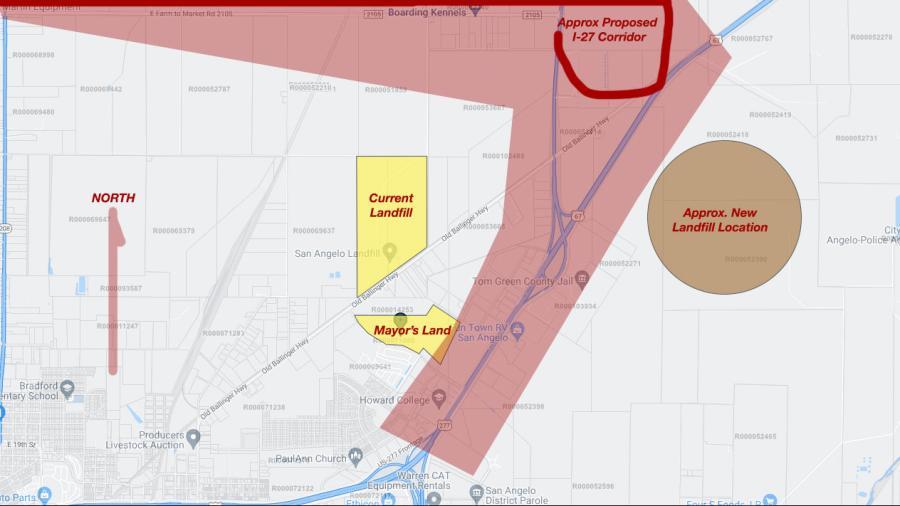
A map of the two landfill locations, the I-27 proposed corridor, and the mayor's land.

Subscribe to the LIVE! Daily

Required
Comments
Listed By: Rita Repulsa
Happy Hispanic Heritage Month!
Be sure to keep up the old Spanish custom of offering friends, neighbors and strangers something with pork in it...
- Log in or register to post comments
PermalinkListed By: Wiley Coyote
We will need AI plant if we gona see any I-27
- Log in or register to post comments
PermalinkPost a comment to this article here: