

By Alejandra Martinez / The Texas Tribune
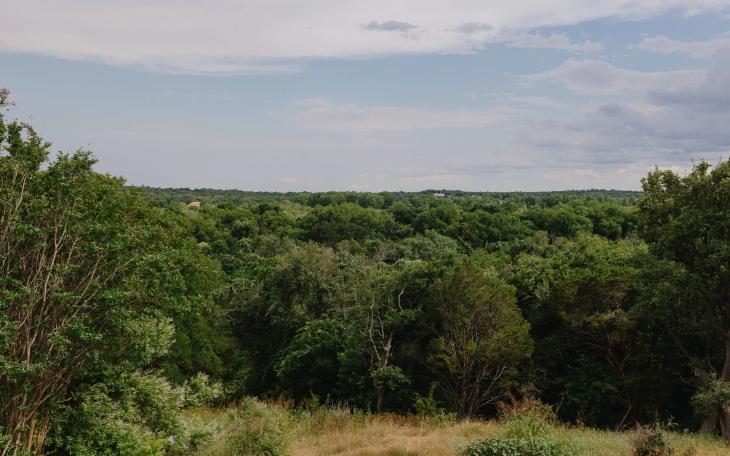
HOOD COUNTY, TX — Brian Crawford points to the top of a hill northwest of his family’s home garden, just past their gently sloping yard dotted with live oaks beginning to flower.
“All of this would be buildings,” said his wife, Laura Crawford.
“A slab of concrete,” Brian added.
Their 118-acre property sits along the Paluxy River Valley. Instead of green, about 600 yards away from their garden, they could soon be looking at 2,100 acres of warehouse-like structures filled with computing servers that process the digital world, flattening their scenic view into something industrial. The site plan calls for a campus that spans almost six times the size of University of Texas at Austin’s main campus. Its Florida-based developer refers to it as the Comanche Circle project, but the eventual company that will run the data center has not been publicly revealed.
This is just the beginning of the data center revolution in Hood County, a rural community of 62,000 people about an hour southwest of Fort Worth. Developers have proposed eight data centers spanning over 7,600 acres, or 12 square miles. While it’s unclear how much power all of the facilities would require, the Comanche Circle data center, plus two other smaller projects from the same developer, could use up to 3 gigawatts of electricity at full capacity, according to its developer — enough to power about 3 million homes. Some of the power could be generated by a new on-site gas plant, and some will likely come from the state’s power grid, according to the project’s concept plan.
Comanche Circle will need an initial one-time “flush and fill” starting next year of 95 million gallons of water for its seven-year buildout, and then 150,000 gallons per day — equivalent to the average use of 500 U.S. households, according to the minutes of the local water district board meeting where the developer made its request. In an email to The Texas Tribune, the developer said that the number submitted to the district board was incorrect and his three data centers combined would use “less than 50,000 gallons per day of groundwater” at full build out.
Hood County locals are relentless in their fight against the data centers, packing county meetings and town halls and voicing their fierce opposition to the facilities threatening to transform their charming, small-town community.
But, county officials say their hands are tied in their ability to stop or slow development. Two efforts by Hood County commissioners to pass a moratorium on data centers failed, as a state lawmaker warned they were acting outside of their authority. And the county has been sued twice by developers — after the local officials rejected one data center’s concept plan, citing a lack of information about critical considerations like where they’d get their water from, and then tabled a vote on another.
“I was elected by the people to represent their opinion,” Kevin Andrews, a Hood County commissioner who has lived in the county for two decades, said in an interview. “But I also have to follow the law … and not get the county sued.”
Data center developers are more frequently choosing rural, unincorporated areas like Hood County because it’s an easier path to build, experts say. In Texas, counties typically don’t have the power to block development — unlike city officials who wield zoning authority.
“Texas has always viewed counties as rural toddlers that can’t be trusted with full powers,” said Robert Paterson, a professor at UT-Austin who specializes in land use and environmental planning.
Nearly half of the planned data centers in Texas are set to be built in unincorporated areas, free of city regulations, according to an analysis by the Texas Tribune. This marks a shift as most existing data centers are clustered in cities, and only 12% are currently in unincorporated areas.
At least one county, which appears to be the first in Texas, recently placed a one-year pause on data center construction, moving ahead despite the legal risks. The action has already prompted a lawsuit against Hill County and its three commissioners by a data center developer seeking $100 million in damages.
Today, Hood County has the sixth-most planned data centers among Texas counties; per square mile, it ranks third. It’s been a magnet for developers because of the cheap land, available power, fiber lines and, importantly, its lack of local business restrictions.
“We love liberty and love a lack of regulation,” said Greg Harrell, chair of the Hood County GOP, at a town hall earlier this year. “Data centers are taking advantage of it. … They saw an opportunity.”
The surge of development here mirrors a data center gold rush across Texas over the past year that is outpacing the speed of regulation. A Texas Tribune analysis found the state has 335 existing data centers, with more than 248 in the works. Only Texas and Virginia, which has been the top state for data centers for the past few years, had more than 100 active projects under way as of March, according to Aterio, a company that tracks industrial development.
Massive data centers are also flooding the Electric Reliability Council of Texas, the state’s main grid operator, with requests for power. As of May, ERCOT reported that large projects requesting to connect to the grid totaled 439 gigawatts of power capacity — five times larger than the all-time peak demand on the state’s grid. Of those projects, about 89% are data centers, though energy experts say it’s unlikely that all of them will be built.
The explosion of development is driven by the newest wave of data centers, known as “hyperscalers,” designed to support artificial intelligence computing facilities with thousands of servers, which are much bigger than current data centers that were largely built for cloud storage. Amazon, Google, Microsoft and Open AI are behind planned projects in West Texas and Central Texas.
“Texas is a great state to do business. All of that really has come together to help make Texas, again, one of the national leaders in digital infrastructure,” said Dan Diorio, vice president of state policy with the Data Center Coalition.
Data center developers say their projects will bring billions of dollars of new property on the tax rolls, work training opportunities, job creation and private investment in communities. One company told Hood County commissioners it could potentially increase the county’s tax base anywhere from $5 billion to $20 billion.
However, some commissioners and residents remain skeptical, saying the benefits are uneven, and data centers create few permanent jobs after their labor-intensive construction is finished. For example, one Hood County data center proposal shows a peak construction workforce of 2,000 dropping to a permanent workforce of 220, according to the project’s concept plan.

Subscribe to the LIVE! Daily

Required
Post a comment to this article here: